
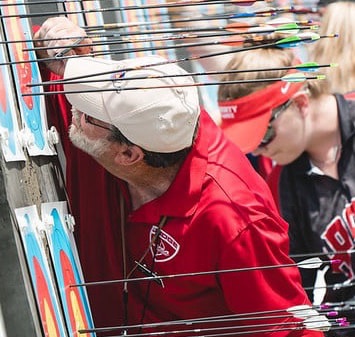
Archers prepare for competitions by practicing their shot process but knowing the ins and outs of scoring is equally important. When archers go to the targets to score their first arrows, they must determine their roles in the scoring process. While only two archers need to be assigned to each target for scoring purposes, there are often more. Ideally, there will be two scorers (one for paper and one electronic or two for paper), a caller, and a verifier. The important thing to know is that all archers can call their arrows, and ALL archers should verify their recorded arrow values. Before calling the arrows, archers must not touch their arrows or the target butt, which includes waiting to mark arrow holes.
As archers call their arrows, they identify which scoring ring the shaft of each arrow falls into, calling out the values in descending order. The arrow receives the higher value if the shaft touches the line between two scoring rings. Occasionally, an archer may disagree with the value given, whether it’s their own or that of a fellow archer. If there’s a disagreement about a value, an archer can raise their hand for a judge, who will make a final call using a magnifying glass to assess the arrow in relation to the scoring rings. The judge’s decision is final.
The scorers are responsible for accurately recording the arrow values called for each archer on the paper scorecards and calculating the totals for each round. Mistakes can happen, but there is a proper procedure for addressing them. Any changes to an arrow value on the scorecard must be made before the arrows are removed from the target, and all archers must initial the change, or a judge must initial it. If initials are missing from the scorecard, the scoring team is not obligated to accept the altered arrow value. No initials are required for corrections made to end totals or running totals due to mathematical errors.
I After an archer has completed all scoring rounds, they should review the arrow values, total scores, and counts of Xs and 10s (9s for indoor) on their scorecard before signing their name, which indicates their agreement with the recorded scores. Understanding the arrow calling and scoring process empowers archers during tournaments and can help preserve their scores, resulting in a positive competition experience.
Written by:
Kristy Wapniarski
Continental Judge | World Archery Americas
National Judge | USA Archery

Leave a comment